
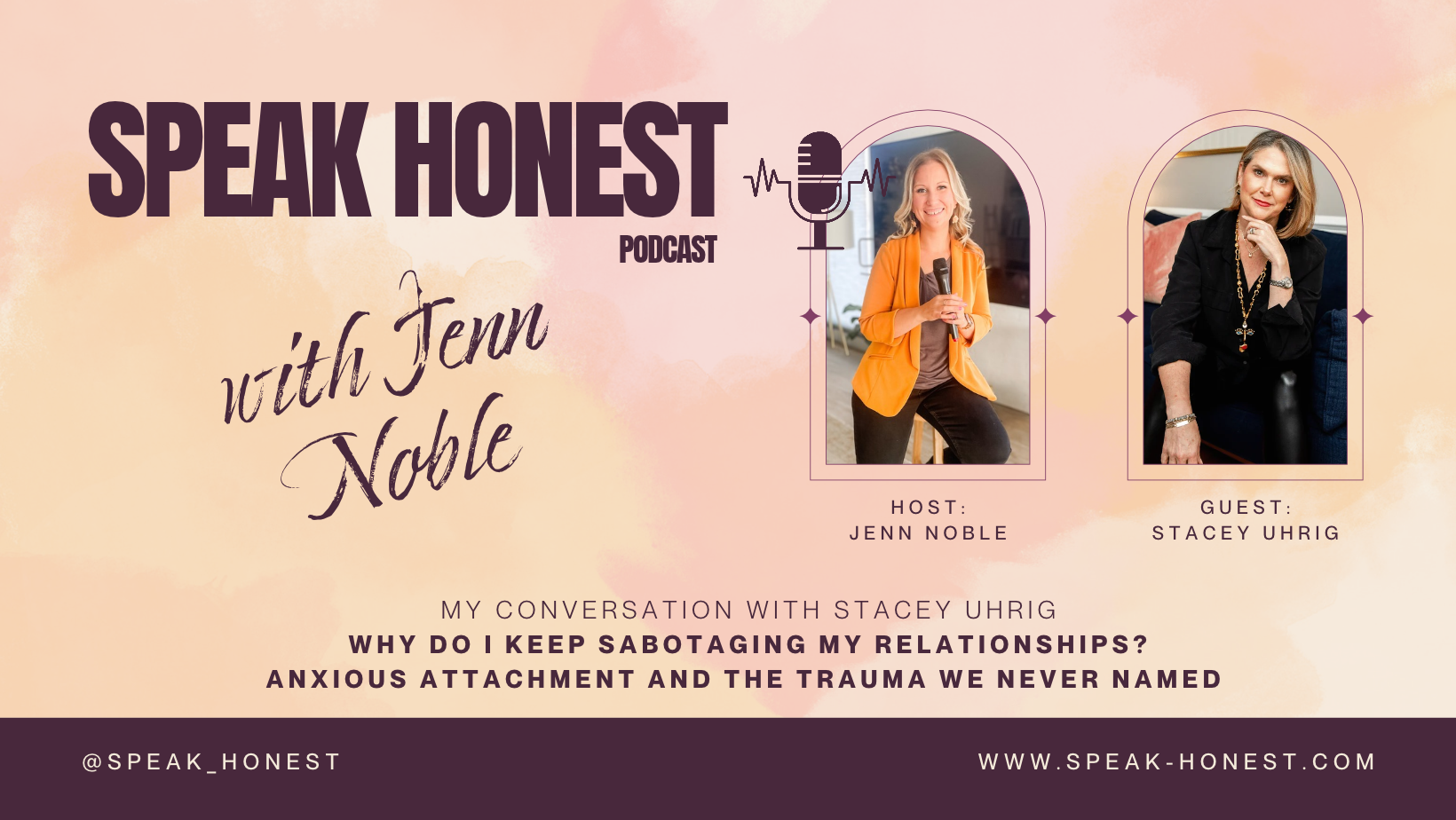
Why Do I Keep Sabotaging My Relationships? Anxious Attachment and the Trauma We Never Named
Want to listen on Apple Podcasts or Spotify? Click on the SHARE (next to more info) option below and Enjoy!
Have you ever watched your partner laugh a little too long at someone else's joke and felt your chest clamp down before your brain even caught up? One minute you're sipping iced coffee on the sidelines of a kids' soccer game, and the next you're mentally drafting the breakup text... all over a friendly hand resting on his arm. (Honey, we have all been there, and some of us were there in very cute sneakers.)
That spiral has a backstory, and it started long before he ever walked into your life. Most of us try to handle it with willpower, one more self-help book, and a solemn vow to be totally chill next time. The pattern starts to soften once we get curious about where it came from, so grab your coffee and get ready to play detective with your own past.
What Happened to You? The Question That Rewrites Self-Sabotage
Physician Gabor Maté famously reframes the question "what's wrong with you?" into "what happened to you?" Trauma care practitioner Stacey Uhrig, founder of Flip Your Mindset, sums up childhood as a cycle of assessing, addressing, and adapting. Tiny humans scan every room for safety, and whenever love, attention, or security feels shaky, we invent a clever way to cope. If the strategy works, it sticks and it becomes the lens we look through in every relationship that follows.
Here's the part that gave me chills. A child who depends on a stressed, distracted, or limited parent is stuck with some terrifying math. If the grown-up is the problem, the kid has zero options, and that feels like pure danger. Should the kid be the problem, she can at least try harder and be a little more lovable tomorrow. So little you took the blame to stay safe, and that belief still pipes up with "he's going to leave, you're unlovable" every time someone touches your partner's sleeve. (That belief has some nerve, if you ask me.)
Why Emotional Neglect Counts as Childhood Trauma
In the late nineties, Vincent Felitti and Robert Anda ran the famous Adverse Childhood Experiences study with the CDC and Kaiser Permanente, linking ten categories of childhood adversity to health outcomes decades later. Stacey loved the research and also noticed how much it missed. She spent a year and a half listening for the common threads keeping her clients stuck, then built the HURRT Assessment (Healing UnResolved Roots of Trauma) to look at adversity, emotional neglect, marginalization, and the resilience factors that helped people cope.
The biggest scores usually show up in emotional neglect. Did you feel seen and heard growing up? Were your feelings welcome at the dinner table? Psychologist Jonice Webb has written for years about how invisible this kind of neglect can be, and Stacey describes trauma as the lasting wound an experience leaves behind. Back in third grade, a teacher used me in front of the whole class as the example of what not to look like. The moment stung, and the pain I carried for decades grew out of coming home in tears to parents who told me to get over it… a wound that deepens in the silence after the hard thing happens.
How It Feels to Stop Fighting Yourself
Think about your old coping strategies like a giant winter coat. When life was freezing, the parka, mittens, and hat kept you alive, and they were the smartest choice available. Now it's summer, and you're still zipped up to the chin wondering why every relationship feels so overheated. Richard Schwartz, who created Internal Family Systems, teaches that there are no bad parts, and Janina Fisher describes so many of the symptoms we pathologize as signals of adaptation. The clingy part, the texting every thirty minutes part, and the part that cries at the thought of him going out all showed up to protect you.
Fair warning, this process feels like the least fun roller coaster at the county fair. Stacey calls healing wildly nonlinear, with loops, drops, and moments where you might want to toss your funnel cake. Some days curiosity comes easily, and other days the inner critic (her name for it is the itty bitty sh*tty committee, and I'm obsessed) gets loud. Both kinds of days count as progress, and your body learns a brand new rhythm every time you pause and get curious.
The Benefits of Getting Curious About Your Patterns
The prize on the other side of that ride is emotional freedom. Your reactions start landing somewhere more neutral, so a hand on his arm registers as "huh, interesting" while your nervous system stays buckled in. Compassion grows in every direction, toward your partner, your parents, and the younger version of you who figured out how to survive. As Stacey loves to say, we do what's familiar even when it isn't functional and once the familiar thing has a name, you get to choose something new.
Here's a bonus for the moms reading this. Adversity is healthy for kids, and the magic happens when a grown-up sits beside them in the hard feeling and shows them how to move through it. Every time you practice sitting with your own discomfort, you model that skill for your children, which means your healing ripples straight down the family tree.
Try This the Next Time You Spiral
Next time your body sounds the alarm, pause and ask yourself two questions. What am I making this mean? And what would I need to believe to stay calm right now? The second question is where the gold hides... for Stacey's client, the answer was "I'd need to know I'm lovable," and suddenly she had a brand new place to start.
If you want a fuller picture of what shaped you, take Stacey's free HURRT Assessment at flipyourmindset.com/hurrt and give yourself permission to be wonderfully curious about your own story. Swap "what's wrong with me?" for "what happened to me?" and notice how much softer everything feels. You get to decide what you carry into your next relationship and what you're finally ready to leave behind 💛
